AI in Agriculture Biotechnology: Reforming Farming Practices
In various industries, artificial intelligence is playing a significant role. In agricultural research and development (R&D) through its spreading its roots via two primary methods: automating labour-intensive tasks and extracting insights from complex, multi-parameter data. By achieving these overarching objectives, artificial intelligence is beginning to expedite improvements in crop quality, enhance disease detection speed, optimise in vitro plant tissue culture more efficiently, and unravel the complex relationships between genetic factors and environmental conditions that influence plant growth, resilience, and crop yield.
The current scenario
The existing literature underscores that we are still in the early stages of applying artificial intelligence in agriculture, with substantial advancements expected in the future. The convergence of cost-effective next-generation sequencing and increasingly potent computer processors has worked their way for genomic selection and genomic prediction using linear models. Furthermore, the integration of artificial neural networks and deep learning holds the promise of significantly enhancing prediction accuracy in the years ahead.
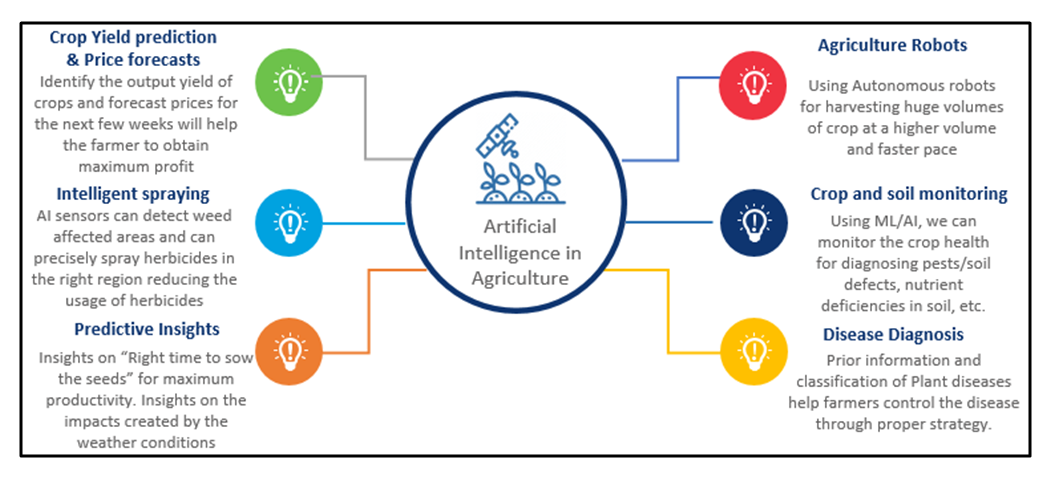
Moreover, progress in drone technology, advanced cameras, and multispectral imaging, coupled with precise, hyperlocal environmental monitoring, is simplifying the creation of comprehensive datasets that capture the influence of the environment on plant biology in real-world agricultural settings. These datasets can be integrated into genomic selection models, adding a crucial layer of environmental information that is often lacking in many existing approaches. AI can be used in utilizing self-operating robots to efficiently and rapidly harvest large quantities of crops. With the assistance of artificial intelligence models, we can observe the condition of crops to detect pests or soil issues for diagnostic purposes.
Precision agriculture
The convergence of artificial intelligence (AI) and biotechnology is poised to revolutionise agriculture across several key domains. In precision agriculture, AI-powered technologies like sensors, drones, and satellite imagery provide real-time crop monitoring and management. By analysing data on crop health and growth, farmers can make informed decisions regarding irrigation, fertilisation, and pest control. Predictive analytics further empower farmers by forecasting weather patterns and disease outbreaks, aiding in scheduling planting and harvests while reducing crop losses. Soil health assessment, facilitated by AI-enabled soil sensors, allows for precise soil management, optimising fertiliser application and crop quality. Artificial intelligence sensors can identify areas infested with weeds and accurately apply herbicides in the correct zones.
Crop improvement is another area where AI shines. Genomic sequencing, supported by AI's data processing capabilities, identifies genes linked to desirable traits, such as drought resistance. Gene-editing technologies, like CRISPR-Cas9, are made more efficient with AI, enabling precise genetic manipulation for enhanced crop characteristics. AI-driven algorithms streamline breeding programs, predicting the genetic potential of parent plants and accelerating the development of new crop varieties with desired traits.
Applications of AI in agriculture
Sustainable farming practices are central to addressing environmental concerns. AI aids resource optimisation by recommending irrigation schedules and minimising waste. Crop rotation strategies improve soil fertility and reduce the need for chemical interventions. Early detection of pests and diseases through AI-powered image recognition systems enables targeted interventions, reducing pesticide use and harm to non-target organisms.
Supply chain efficiency benefits from AI in inventory management, predicting supply and demand, and enhancing food traceability through blockchain technology. AI-driven inventory optimisation minimises waste and ensures resource availability. Predictive insights on crop yields and prices empower farmers to make informed marketing decisions. Food traceability fosters consumer trust and rapid product identification in food safety incidents.
Challenges and limitations
However, the potential of AI in agriculture comes with challenges. Data privacy concerns arise from extensive data collection, necessitating assurances of data security and responsible use. Equitable access to AI and biotechnology tools is essential, bridging the digital divide between small-scale and commercial farmers. Environmental impact from AI hardware and data centres calls for energy-efficient solutions. Maintaining genetic diversity is vital to prevent over-reliance on genetically modified crops.
Conclusion
The fusion of AI and biotechnology is leading in a new era of agriculture, marked by heightened productivity, sustainability, and resilience. AI benefits precision agriculture, crop enhancement, sustainable farming, and supply chain efficiency. Ethical considerations must be addressed, but AI's potential in agriculture is too significant to ignore. Striking a balance between technological progress and environmental stewardship is crucial. AI in biotechnology can feed a growing population while protecting the planet. With ongoing research, investment, and collaboration between agriculture and technology, we can unlock greater potential, ensuring a sustainable and prosperous future for agriculture and humanity.
MD: Discover how AI is changing the field of agriculture through precision farming, crop improvement, and sustainable practices. Explore real-time monitoring, predictive analytics, and environmental impact. Uncover the challenges and ethical considerations in harnessing AI's potential for a sustainable future in agriculture.
 A story of Glucose, Insulin and Cancer Cell Growth
 Basics of Behavioural Genetics
 Benign vs. Malignant Tumors: Understanding the Critical Distinction