
Punnett Square: Predicting Progeny
The Punnett square, named after British geneticist Reginald Punnett, is a powerful tool in genetics used to predict the outcomes of genetic crosses. It provides a visual and systematic method for understanding how genes are inherited and expressed in the offspring of two parents. By arranging alleles from each parent, the Punnett square allows us to anticipate the genetic makeup of the progeny and gain insights into traits, diseases, and other hereditary factors.
Key Concepts to Remember
1. Alleles: Alleles are different versions of a gene that can occupy a specific location, or locus, on a chromosome. For each gene, an individual inherits one allele from each parent.
2. Dominant and Recessive Alleles: In some gene pairs, one allele may be dominant, while the other is recessive. The dominant allele is expressed in the offspring, whereas the recessive allele is only expressed if both alleles are recessive.
3. Genotype and Phenotype: The genotype refers to the genetic makeup of an organism, while the phenotype represents the physical or observable characteristics resulting from the genotype.
Constructing a Punnett Square
A Punnett square is a simple grid with two columns and two rows. The columns represent the alleles from one parent, while the rows represent the alleles from the other parent. By filling in the square with the alleles, we can visualize the possible combinations of alleles in the progeny.
Let's take a classic example: Mendel's pea plant experiment with shape of the seed. In this case, there are two alleles for the shape of the seed, denoted as "P" for Round (dominant) and "p" for Wrinkled (recessive).
- The first parent's genotype is PP (homozygous dominant), meaning both alleles are for the round seeds.
- The second parent's genotype is pp (homozygous recessive), indicating both alleles are for the wrinkled seeds.
To predict the progeny's genotype, we construct a Punnett square like this:
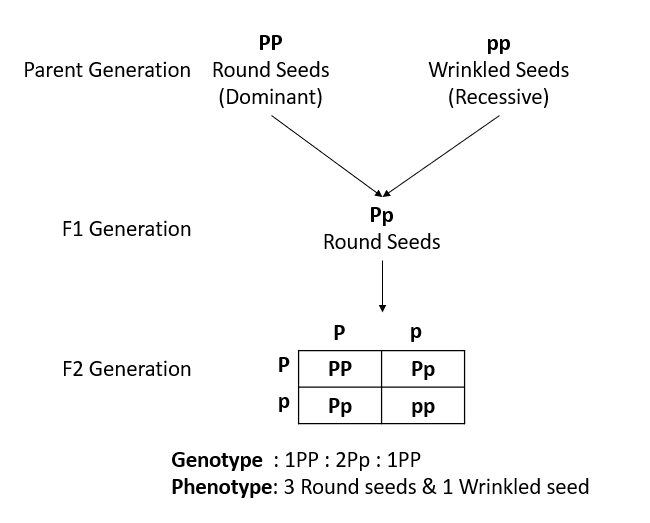
(I have created the image. Kindly use this.)
Applications of Punnett Squares
1. Monohybrid Cross: Involves the study of one gene and the prediction of the offspring's genotype and phenotype for that specific trait.
2. Dihybrid Cross: Focuses on two genes, often on different chromosomes, allowing for the prediction of the inheritance of two traits simultaneously.
3. Test Cross: Determines the genotype of an organism with a dominant phenotype by crossing it with a homozygous recessive individual.
4. Sex-Linked Inheritance: Examines the inheritance of traits carried on sex chromosomes (X and Y), particularly for predicting the chances of sex-linked genetic disorders.
5. Incomplete Dominance: Deals with traits where neither allele is completely dominant, resulting in an intermediate or blended phenotype.
6. Codominance: Occurs when both alleles for a gene are fully expressed in the heterozygous individual, leading to a unique phenotype.
Limitations of Punnett Squares
1. Punnett squares assume independent assortment, which may not hold true for all genes. Some genes are closely linked on the same chromosome and tend to be inherited together.
2. Punnett squares are primarily designed for analyzing one gene at a time, making them less suitable for multifactorial traits influenced by multiple genes.
3. In reality, genetic inheritance is more intricate due to factors like genetic linkage, environmental influences, and gene interactions, which Punnett squares do not account for.
Conclusion
The Punnett square is a fundamental tool in genetics, providing a systematic way to predict the outcomes of genetic crosses and gain insights into heredity. It simplifies the complexities of genetic inheritance and serves as a foundation for understanding Mendel's laws, probability predictions, and the basics of genetics. While Punnett squares have their limitations, they remain an invaluable resource for geneticists, researchers, and educators, helping us unlock the secrets of inheritance and the diversity of life.
MD: Learn and understand how punnet squares works, its applications and the limitations of punnet squares.
 A story of Glucose, Insulin and Cancer Cell Growth
 Basics of Behavioural Genetics
 Benign vs. Malignant Tumors: Understanding the Critical Distinction