Unravelling the Legacy: Inheritance Patterns of Mendelian Genetics
Mendelian genetics, named after the Austrian monk Gregor Mendel, is the cornerstone of modern genetics. Mendel's work, published in the mid-19th century, uncovered the fundamental principles of inheritance that govern the transmission of traits from one generation to the next. Mendelian inheritance patterns are not limited to traits; they also apply to certain diseases.
Mendel's Laws
Gregor Mendel's groundbreaking experiments with pea plants uncovered three fundamental laws that underpin Mendelian genetics:
The Law of Segregation: Mendel's first law states that each individual has two alleles for a given trait, one from each parent. These alleles segregate during gamete formation, with each gamete carrying only one allele. Upon fertilization, the offspring inherit one allele from each parent, resulting in genetic diversity.
The Law of Independent Assortment: Mendel's second law, the Law of Independent Assortment, applies to genes on different chromosomes. It states that alleles of different genes segregate independently during gamete formation. This principle contributes to the genetic diversity observed in offspring and allows for the inheritance of traits separately.
The Law of Dominance: Mendel's third law, the Law of Dominance, addresses the interaction of alleles within an organism. It posits that one allele (the dominant allele) may mask the expression of another allele (the recessive allele) in a heterozygous individual. Only when two recessive alleles are present will the recessive trait be expressed.
https://www.shutterstock.com/image-vector/gregor-mendel-his-experiment-pea-plants-1730127778
Types of Mendelian Inheritance
Mendelian genetics encompasses various inheritance patterns, each determined by the combination of alleles for a given gene. Here are some key types of Mendelian inheritance:
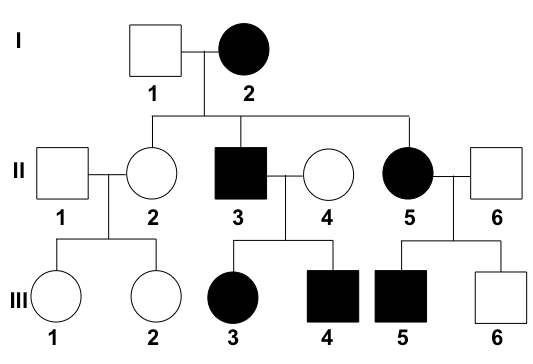
- Autosomal Dominant Inheritance: In this pattern, a single copy of the dominant allele is sufficient to express the trait. Individuals with one or two dominant alleles exhibit the dominant trait, while those with two recessive alleles show the recessive trait. Huntington's disease is an example of an autosomal dominant disorder.
- Autosomal Recessive Inheritance: Autosomal recessive inheritance occurs when an individual must inherit two copies of the recessive allele to express the trait. Heterozygous carriers (with one dominant and one recessive allele) do not display the trait but can pass the recessive allele to their offspring. Examples include cystic fibrosis and sickle cell anemia.
- X-Linked Dominant Inheritance: X-linked dominant traits require only one copy of the dominant allele for expression. Affected individuals can inherit the dominant allele from either parent.
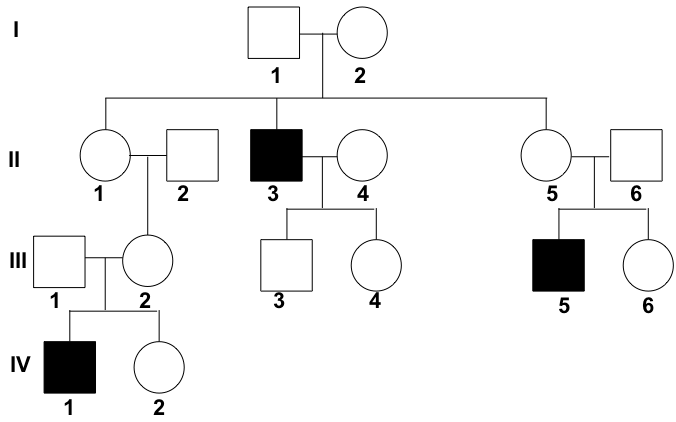
- X-Linked Recessive Inheritance: This pattern of inheritance is linked to genes located on the X chromosome. Since males have one X and one Y chromosome, they exhibit X-linked recessive traits when they inherit one recessive allele. Females, who have two X chromosomes, must inherit two recessive alleles to express the trait. Hemophilia and color blindness are X-linked recessive disorders.
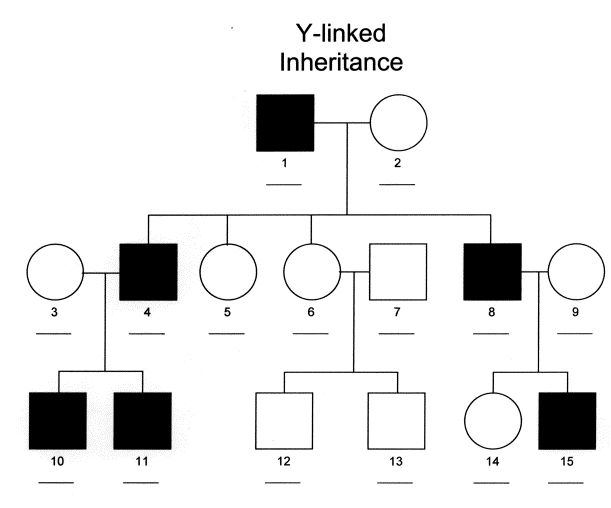
- Y-Linked Inheritance: Y-linked traits are limited to males since the Y chromosome is unique to them. These traits are typically related to male sex determination and fertility, and they are passed directly from father to son.
- https://cdn.kastatic.org/ka-perseus-images/096f00d7597a7b640e5675cdd51259a2fdf817f1.png
- https://migrc.org/wp-content/uploads/Autosomal-Recessive-Pedigree-Chart-800x598.gif
- https://www.researchgate.net/profile/Boris-Sharga/publication/327666985/figure/fig1/AS:671066267611136@1537006074197/X-linked-dominant-trait-pedigree-By-Diana-B-Pylypiv.png
- https://cdn.kastatic.org/ka-perseus-images/3622fd46c0cec01c9ad9d69255f81554ab78595e.png
- https://migrc.org/wp-content/uploads/Y-Linked-Inheritance-Pedigree-Chart.gif
COMBINE ALL 5 IMAGES
Applications in Human Genetics
Mendelian genetics plays a crucial role in human genetics and medical research. Understanding Mendelian inheritance patterns is essential for predicting the probability of certain genetic disorders in families and developing strategies for disease prevention and management. Genetic counseling, carrier screening, and prenatal testing are all informed by Mendelian principles.
Conclusion
The inheritance patterns of Mendelian genetics, as outlined by Gregor Mendel's laws, are fundamental to our understanding of heredity and genetic diversity.
MD: Discover the principles of Mendelian inheritance patterns and unravel the secrets of genetic transmission.
 A story of Glucose, Insulin and Cancer Cell Growth
 Basics of Behavioural Genetics
 Benign vs. Malignant Tumors: Understanding the Critical Distinction